How To Plan Choosing A Portable Tyre Inflator For Home Use
A practical step-by-step guide to how to plan choosing a portable tyre inflator for home use, including preparation, instructions, common issues, tips, and next steps.
How To Plan Choosing A Portable Tyre Inflator For Home Use
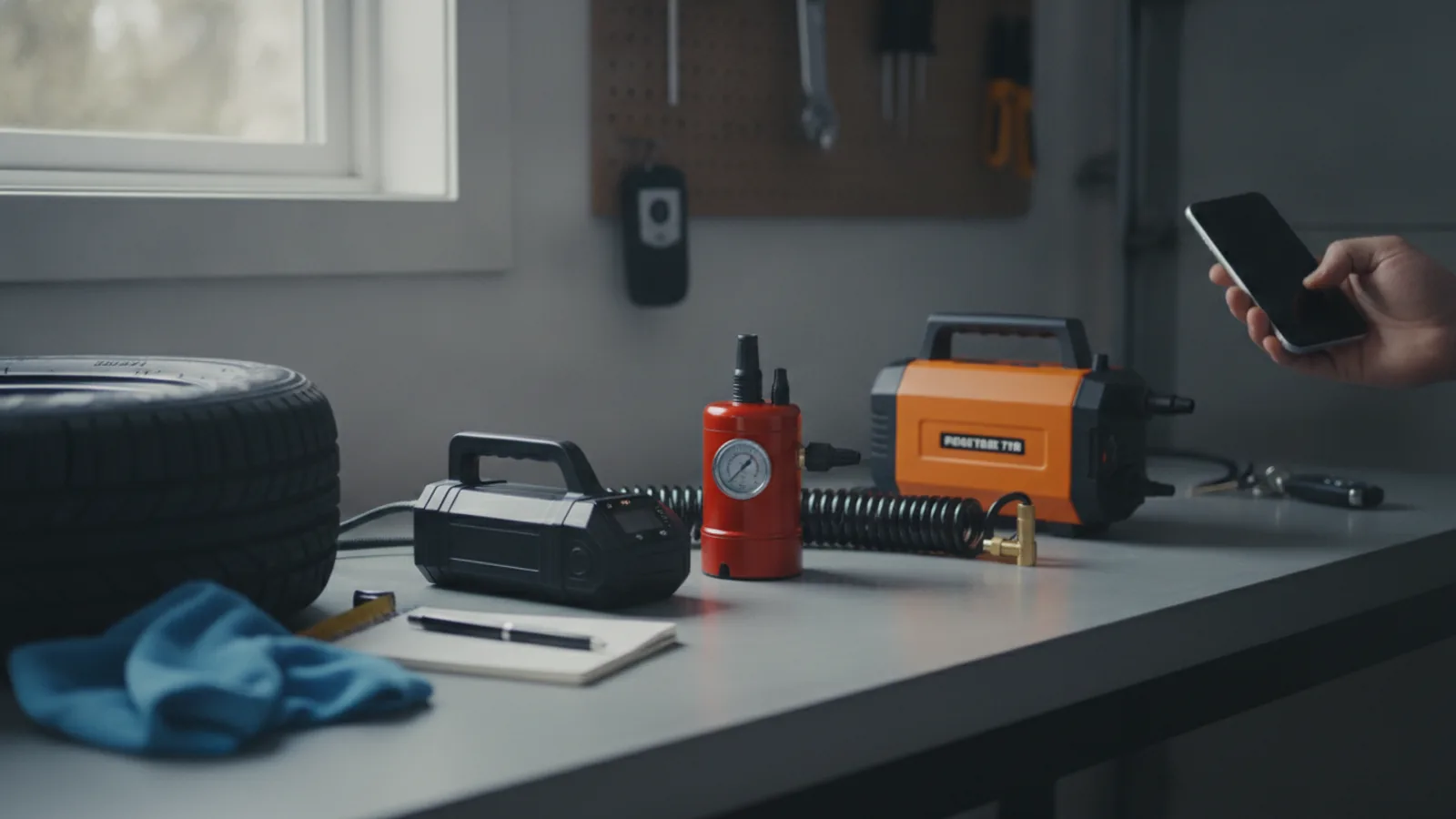
Choosing a portable tyre inflator for home use involves matching your vehicle's tyre pressure needs, inflation speed, power source, and build quality to your typical usage patterns. This guide helps you evaluate key features, measure your requirements, and make a practical decision without overspending or compromising safety. You'll learn to compare specs, test for real-world usability, and avoid common pitfalls like poor pressure gauges or overheating units.
Fast Answer
- First, note your vehicle's recommended tyre pressure (usually on a door jamb sticker or owner's manual) and select an inflator whose pressure range and accuracy exceed that value.
- Then, choose between a 12V car-powered unit for occasional topping up or a rechargeable model for cordless convenience; verify it can reach your tyres' pressure without struggling.
Before You Start
- Find your vehicles' recommended tyre pressure values, typically listed on a sticker inside the driver's door frame, in the fuel flap, or in the owner's manual; record them for every vehicle you plan to inflate.
- Measure the distance from your car's power outlet (or a planned battery connection) to each tyre valve to ensure the inflator's cord or hose length is adequate.
- Estimate how often you'll use the inflator: weekly checks, monthly top-ups, or after seasonal temperature changes; this affects whether a basic unit or a higher-duty model is worth it.
- Decide on a budget range and list features you consider essential, such as an accurate gauge, automatic shut-off, or a bright light, but avoid anchoring on specific brand names.
Step-by-Step Instructions
Assess Your Tyre Pressure Needs
Begin by recording the recommended cold tyre pressure for every vehicle you own. Look for a sticker on the driver's side door jamb, inside the fuel flap, or in the owner's manual. Cold pressure means the tyre hasn't been driven in the last three hours. This value is the target you'll use to set the inflator. Also note the tyre size, though it's less critical for pressure selection. If you have a trailer, bicycle, or other inflatables, list those pressures too. Understanding these numbers helps you choose an inflator whose pressure range and resolution cover all your needs, and it prevents you from under- or over-inflating. A common mistake is using the maximum pressure printed on the sidewall, which is not the recommended operating pressure. Write these figures on a card and keep it in your glovebox for quick reference when you're away from home.
Determine Power Source and Cord Length
Decide where the inflator will get power. Most household units use a 12V accessory socket (cigarette lighter) in your car, but some come with a rechargeable battery and a home power adapter. Measure the distance from that power point to the farthest tyre on your vehicles, accounting for the hose and cord routing around the car. If the cord is too short, you may struggle to reach the rear tyres on a truck. For rechargeable models, consider the battery capacity, but note that higher capacity usually adds weight and cost. Alternatively, some inflators have a built-in battery but can also plug into a wall outlet at home. If you plan to use it mainly at home, a corded electric model may be sufficient; if you travel, opt for a 12V or rechargeable unit. Check that the included hose length is at least enough to reach from the power source to the valve without stretching.
Evaluate Pressure Gauge and Accuracy
The pressure gauge is your primary tool for correct inflation. Look for a digital display that shows the pressure in PSI, BAR, or kPa, and check if it can be set to your desired target with a preset function. Accuracy matters: many budget inflators are off by 1-2 PSI, which can be significant for low-pressure tyres like those on bicycles. To test accuracy, compare the inflator's reading with a known accurate digital gauge before relying on it. Check if the gauge is backlit for use in dim conditions. An automatic shut-off feature stops inflation when the preset pressure is reached, preventing over-inflation. This is especially useful if you're filling multiple tyres and might get distracted. Manual gauges are less common on portable inflators, but if you see one, ensure it has a clear face and a bleed valve to release excess air.
Check Inflation Speed and Duty Cycle
Inflation speed is measured in litres per minute or time to fill a standard car tyre from flat to recommended pressure. Faster units are convenient but may use more power. Look for a spec that indicates time to inflate a 195/65 R15 tyre from 0 to 30 PSI; typical is around 3-5 minutes. Also consider the duty cycle, often shown as '10 minutes on, 30 minutes off' or a percentage. This tells you how long you can run the inflator continuously before it needs to cool down. If you often inflate multiple tyres, a longer duty cycle is better. Running the unit beyond its duty cycle can overheat the motor or damage the electronics. For home use, a moderate speed and a 15-minute continuous run time is sufficient. But if you have a large SUV or truck, a faster unit with a higher-duty motor is worth the expense.
Assess Build Quality and Portability
Inspect the casing, chuck, and hose for sturdiness. A metal cylinder and shock-resistant plastic body indicate better build quality. The chuck should fit securely on your valve stems; most units come with a screw-on or clamp-type connector. Check that the hose is reinforced to resist kinking. Weight and size matter for portability: a compact model that fits in your trunk under the floor panel is ideal. Consider the storage case, whether it's a zippered bag or a hard shell, as it protects the unit from dust and damage. Also, check the length of the power cord—longer is easier, but you may also need an extension cord for 12V use in larger vehicles. Look for a integrated LED light for illuminating the work area at dusk. These quality indicators reduce the risk of premature failure and make the device pleasant to use.
Compare Essential Features and Choose
Make a shortlist of models that meet your pressure range, power source, and speed criteria. Compare the extra features: automatic shut-off, multiple nozzle adapters for sports balls and air mattresses, a built-in pressure release valve, and perhaps a digital readout with a backlight. Think about the ergonomics: is the handle comfortable, are the buttons easy to operate with gloves? Read customer reviews for real-world reliability, but ignore one-off complaints. Finally, verify after-sales support: does the manufacturer offer a warranty and how long? A longer warranty often signals confidence in the product. Choose the unit that gives you the best balance of practicality and cost, not the cheapest or the most expensive. Remember that the inflator is a tool, not a toy; a quality unit will last years. Once purchased, test it at home with a known tyre pressure before relying on it on the road.
Quick Reference
| Situation | Action | Why it helps |
|---|---|---|
| You're buying an inflator for a family car and occasionally a bicycle. | Choose a compact 12V unit with a digital gauge, automatic shut-off, and a few nozzle adapters; ensure the pressure range covers up to at least 50 PSI. | This covers typical car pressures and bicycle tyres, and automatic shut-off prevents over-inflation during distractions. |
| You have an SUV with large tyres that are often a few PSI low due to temperature changes. | Opt for a rechargeable or 12V unit with a higher inflation speed (at least 30 litres per minute) and a duty cycle of 15 minutes continuous. | Larger tyres require more air volume and a longer runtime to top up all four without overheating the unit. |
| You seldom use the inflator and want a simple, inexpensive unit for emergencies. | Select a basic 12V inflator with a analog gauge and a simple on/off switch; verify the cord reaches your tyres and store it in your trunk. | It provides essential functionality without extra features you won't use, reducing cost and potential failure points. |
Common Issues
- The inflator's gauge gives inconsistent readings compared to a known good gauge.: Use a separate high-quality tyre pressure gauge to check readings and adjust your inflation target by the difference. If the inflator is consistently off, you can compensate, but consider returning it if inaccurate by more than 2 PSI.
- The inflator overheats and shuts off after inflating only two tyres.: Observe the duty cycle specification and allow the unit to cool for the recommended time. If running beyond the duty cycle, pause and resume after 20 minutes. For frequent use, choose a model with a longer run time or a metal cylinder that dissipates heat better.
- The air chuck doesn't fit securely on the valve stem, causing air leaks while inflating.: Check if your valve stems are the standard Schrader type; most cars are, but bicycles may have Presta valves. Use the included adapter or purchase one. Ensure the chuck is fully tightened and seals. If the chuck is stripped, replace it with a generic brass connector.
Advanced Tips
- Keep a spare fuse for the 12V plug in your glovebox, as a blown fuse is a common cause of failure.
- Store your inflator in a temperature-controlled environment to preserve the motor and plastic parts.
- Before long trips, inflate your tyres when cold, and re-check on arrival to account for pressure increase due to heat.
Final Checklist
- Record the recommended cold tyre pressures for all your vehicles and keep them in the glovebox.
- Verify the inflator's cord and hose length can reach all tyres from the power source in your vehicle.
- Test the inflator's gauge accuracy against a separate gauge and note any offset.
- Confirm the inflator can run continuously long enough to inflate all tyres to the correct pressure without tripping thermal protection.
FAQ
Should I choose a 12V or rechargeable portable tyre inflator for home use?
It depends on your habits. If you plan to use it mostly in your driveway or garage, a 12V unit that plugs into your car's outlet is simpler and often cheaper. But if you find it inconvenient to start your car or run an extension cord, a rechargeable model offers portability. Consider battery life and recharge time; a battery that takes long to charge might be a nuisance. For occasional home use, a 12V unit is sufficient. For frequent use and convenience, rechargeable is worth the extra cost.
How accurate does the pressure gauge on a portable inflator need to be?
For safety and performance, accuracy within +/- 2 PSI is acceptable for typical car tyres. However, for bicycle tyres with lower pressures, a difference of 1 PSI can matter. You can test the gauge's accuracy by comparing it with a known reliable digital gauge. If your inflator has a preset function, set it slightly higher if the gauge reads low. Never rely solely on the inflator's gauge if it's inconsistent; always use a separate gauge to verify final pressure.
Can I use a portable tyre inflator to inflate air mattresses or sports balls?
Yes, many portable inflators come with a set of nozzle adapters for such purposes. However, the inflation speed and pressure control may not be ideal: air mattresses require low pressure and high volume, while sports balls need precise low pressure. Check if the inflator can handle continuous low-pressure operation without overheating. Use the appropriate adapter and monitor the pressure carefully to avoid over-inflating and damaging the item.