Common Mistakes When Planning Preparing Tyres For A Long Motorway Journey
A practical step-by-step guide to common mistakes when planning preparing tyres for a long motorway journey, including preparation, instructions, common issues, tips, and next steps.
Common Mistakes When Planning Preparing Tyres For A Long Motorway Journey
Planning and preparing tyres for a long motorway journey requires more than a quick visual check. Many drivers make common mistakes such as neglecting pressure checks when tyres are cold, overlooking tread depth variation, forgetting to inspect the spare, and ignoring unusual vibrations. This guide outlines a systematic approach, from gathering tools to post-journey inspection, ensuring safety, comfort, and efficiency on the motorway. By following these steps, you can avoid breakdowns, reduce fuel consumption, and extend tyre life. The guide also addresses frequent issues like under-inflation and uneven wear, offering practical fixes and advanced tips for a smooth and safe trip.
Fast Answer
- Check tyre pressure when tyres are cold, using the vehicle manufacturer's recommended figures, and adjust before driving, not after a long stretch.
- Inspect tread depth across the entire tyre surface, including the outer edges, and look for uneven wear, cracks, or bulges; replace if worn below the legal minimum.
Before You Start
- Gather a reliable tyre pressure gauge, a tread depth gauge or a 20p coin, and the vehicle's handbook or door pillar sticker for the correct pressures.
- Clean the valve caps and check that the valve stems are not cracked or leaking; replace any damaged caps before fitting the gauge.
- Find a level, safe area away from traffic to perform checks, and ensure the tyres are cold, meaning the vehicle has not been driven for at least three hours.
- Make a note of your intended load, as rear pressures may need to be higher for a fully loaded car; consult the handbook for load-specific settings.
Step-by-Step Instructions
Check tyre pressure with a cold gauge
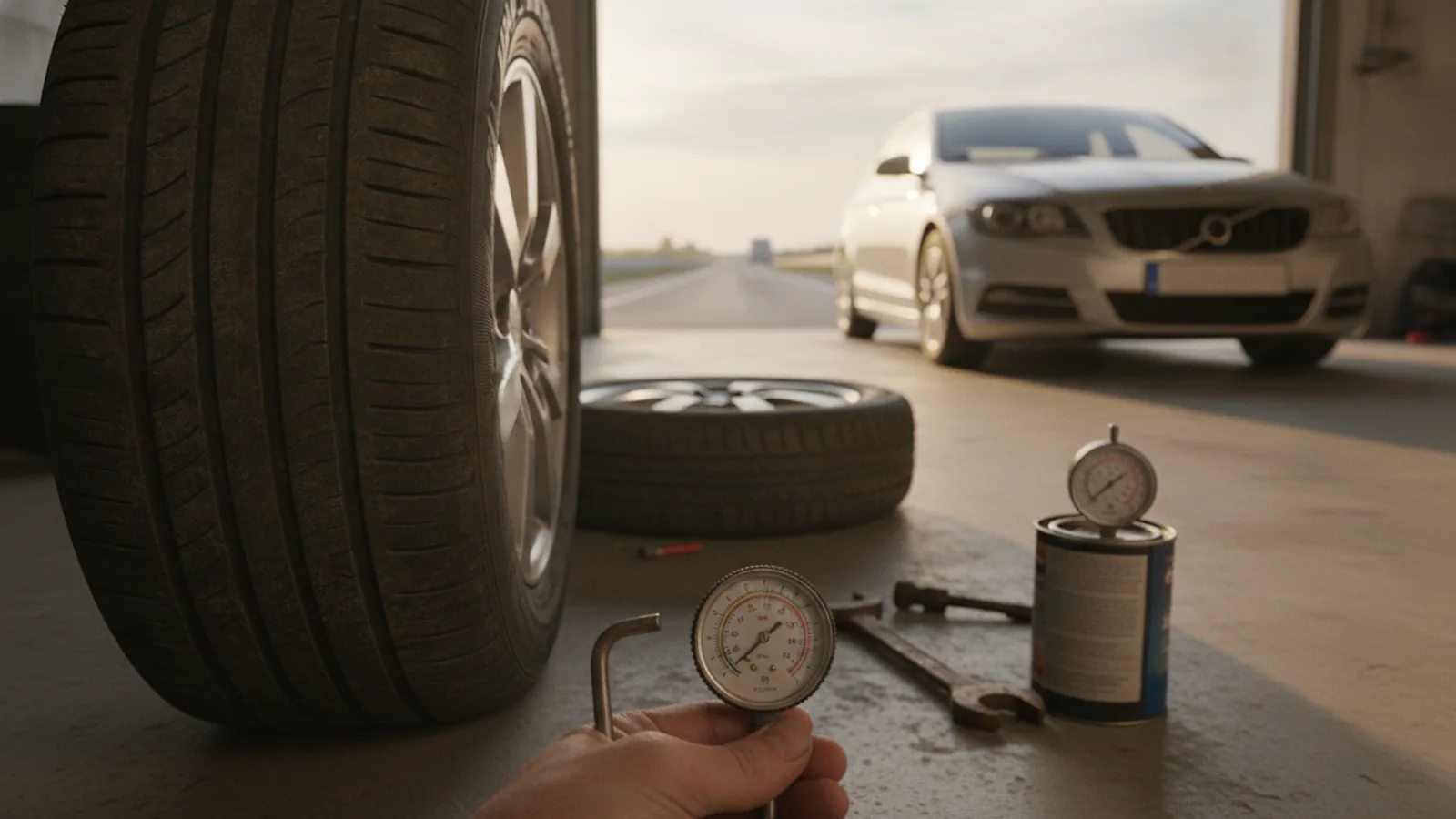
Before any long motorway journey, tyre pressure must be checked when the tyres are cold, meaning the vehicle has not been driven for at least three hours or has been driven less than a mile at low speed. Heat from driving raises pressure, giving a false reading that leads to under-inflation if you compensate. Use a reliable gauge and refer to the manufacturer's recommended pressures, which are usually found on a sticker inside the driver's door frame or in the handbook. Compare each tyre's reading to the specification, and adjust using an air compressor at a petrol station or a home pump. Remember to check the spare if fitted, as it is often forgotten. Under-inflation increases rolling resistance, reduces fuel economy, and causes excessive heat buildup, which can lead to a blowout. Over-inflation reduces grip and causes premature centre wear. By setting the correct cold pressure, you ensure optimal contact patch, balanced wear, and safe handling throughout the journey.
Inspect tread depth across the entire tyre
Tread depth is crucial for maintaining grip, particularly on wet motorways where aquaplaning is a risk. Use a tread depth gauge to measure the main grooves across the centre and both edges of each tyre. The legal minimum is 1.6mm across the central three-quarters of the tread, but for safety, consider replacing tyres when they reach 3mm. Insert the gauge at several points around the circumference and note any significant differences. Worn outer edges indicate under-inflation, while worn centre suggests over-inflation. Uneven wear between tyres may point to alignment issues. Insufficient tread depth reduces water evacuation, increases stopping distances, and raises the chance of aquaplaning. It also compromises handling during emergency manoeuvres. If any tyre is below the minimum or shows bald patches, replace it before starting your journey. Remember to check the spare as well, as it may be old or under-inflated.
Look for cuts, bulges, and foreign objects
A thorough visual inspection of each tyre's sidewall and tread surface can reveal hidden dangers. Look for cuts, cracks, bulges, or blisters, which indicate internal damage that could lead to a blowout. Also, scan for embedded stones, nails, or other sharp objects that may have penetrated the rubber. These may not have caused an immediate leak but could worsen at speed. Run your hand carefully over the tread and sidewalls to feel for any irregularities. Pay special attention to the sidewall, as damage there is often not repairable. If you spot a bulge, do not drive on that tyre; replace it immediately. A puncture in the tread may be repairable if it is smaller than 6mm and located away from the sidewall, but professional advice is essential. Ignoring such damage risks a sudden failure, especially under the sustained high speeds and heat of a motorway run. A thorough check now can save you from a dangerous breakdown later.
Verify wheel alignment and balance
Proper wheel alignment ensures that all four tyres point in the same direction and wear evenly. Misalignment, often caused by hitting potholes or kerbs, leads to uneven wear and increased rolling resistance. Symptoms include pulling to one side, uneven tyre wear patterns, or a steering wheel that is off-centre when driving straight. If you notice any of these, have the alignment checked and adjusted professionally before a long trip. Similarly, wheel balance ensures that each wheel rotates without vibration. Unbalanced wheels cause the steering wheel to shake at certain speeds, typically around 50-70 mph, leading to driver fatigue and premature suspension wear. You can check balance by looking for cupped or scalloped wear on the tread. If vibration is felt, visit a tyre centre to have the wheels rebalanced. Correct alignment and balance improve fuel efficiency, extend tyre life, and provide a smoother, safer ride on the motorway.
Ensure your spare tyre is ready
The spare tyre, whether a full-size spare, space-saver, or a can of sealant, must be in perfect condition to be of help in an emergency. Many drivers forget to check the spare, only to find it flat or unusable when needed. If your vehicle has a full-size spare, check its pressure with the gauge and inflate it to the manufacturer's recommended pressure, which may be higher than the standard tyres. Inspect it for cracks, bulges, or tread wear. If you have a space-saver, note that it is designed for temporary use only, with a maximum speed limit usually printed on the sidewall, and ensure it is inflated correctly. For cars without a spare, check the sealant kit's expiry date and that the compressor works. Also, verify that you have the necessary tools: a jack, wheel wrench, and any adapters. Practice changing a wheel at home so you are familiar with the procedure, as stress can make it challenging on the roadside.
Adapt pressures and loading for the journey
On a long motorway journey, you may be carrying additional passengers or luggage, which increases the load on your tyres. The correct pressure depends on load: under-inflated rear tyres with a heavy load can overheat and blow out. Consult your vehicle handbook or door sticker for the recommended pressures for 'normal' versus 'fully loaded' conditions. E.g., many cars require higher rear pressures when loaded. Adjust all four tyres accordingly before setting off, and remember that pressures should be checked when cold. If you load the car evenly, ensuring weight is distributed properly, you reduce stress on individual tyres. Also, reconsider any unnecessary heavy items in the boot to lighten the load, improving fuel economy and reducing tyre wear. Overloading can also affect vehicle handling and braking distances, so be realistic about what you need to take. Properly adjusted pressures for your journey's load ensure even tread wear, better fuel efficiency, and a safer, more stable ride on the motorway.
Quick Reference
| Situation | Action | Why it helps |
|---|---|---|
| Tyre pressure warning light illuminates on the dashboard during the journey. | Do not panic. Safely reduce speed, avoid hard braking or sharp steering, and pull over at the next safe place, such as a service station or hard shoulder. Inspect the tyre visually for obvious damage or deflation. If it looks low, use a portable compressor or roadside assistance to inflate it to the recommended cold pressure after the tyre has cooled. If you have a usable spare, consider changing it if the tyre is significantly under-inflated. Monitor the pressure warning system after reinflation. | A sudden loss of pressure can cause the vehicle to become unstable, especially at high speeds. Reducing speed and stopping safely minimises the risk of an accident or further tyre damage. |
| You notice a vibration in the steering wheel or a pulling to one side while driving at motorway speed. | Take the next exit or pull into a service area as soon as it is safe. Check the tyre pressures and inspect for any visible bulges, cuts, or embedded objects. If nothing looks wrong, it could be due to wheel imbalance or misalignment. Do not continue if the vibration is severe. Reduce your speed and drive cautiously to a nearby tyre specialist to have the wheels balanced and alignment checked. | Vibrations and pulling indicate potential wheel or tyre issues that could worsen, leading to loss of control. Addressing them promptly ensures your safety and prevents further damage. |
| After a long motorway drive, you notice one tyre feels hotter than others when you stop. | Let the tyre cool down for at least an hour, then check its pressure with a gauge. Compare it to the recommended cold pressures. If the pressure is significantly lower, there may be a slow leak or internal damage. Inflate to the correct pressure and monitor it. If the problem persists or the tyre shows signs of damage, replace it before further driving. | A tyre that runs hotter than others often indicates under-inflation or mechanical issues like dragging brakes, which can cause an eventual blowout. Early detection prevents a dangerous failure on future trips. |
Common Issues
- Tyre pressure checked after a long drive, giving a high reading, and then released to match the recommended cold pressure.: Always check and adjust tyre pressures when tyres are cold (vehicle not driven for at least 3 hours). If you must check when hot, do not release air; the reading will be higher due to heat. Instead, recheck later when cold and adjust if necessary. Never let hot air out, as that will lead to under-inflation.
- Tread depth appears illegal, but you are unsure how to measure accurately.: Use a dedicated tread depth gauge, inserting it into the main grooves at various points, and take the lowest reading. If the tread reaches the legal minimum of 1.6mm across the central three-quarters, the tyre must be replaced. Alternatively, use the 20p coin test for a quick check, but a gauge is more precise. Do not rely on the wear indicator bars alone, as they are not always easy to see.
- You find a small nail in the tread, but the tyre is not losing pressure quickly.: Do not remove the nail. Drive slowly to a tyre specialist. If the puncture is in the tread and smaller than 6mm, it may be repairable by professionally fitting a plug and patch from the inside. Do not attempt a DIY repair kit on a long journey, as it is often temporary. If the sidewall is punctured or the damage is large, the tyre must be replaced.
Advanced Tips
- Consider using nitrogen instead of air for tyre inflation, as it reduces pressure loss over time and maintains more consistent pressures under heat, though it is not necessary for everyday driving.
- When loading the car, distribute weight evenly and secure cargo to prevent shifting, as uneven loading can put excessive strain on individual tyres and cause them to overheat.
- Use a tyre pressure monitoring system (TPMS) if your car does not have one; it provides real-time alerts to slow punctures and leaks, giving you time to react safely.
Final Checklist
- Check all four tyres plus the spare for correct cold pressure according to the vehicle's specification for your expected load.
- Inspect tread depth on each tyre using a gauge, ensuring no tyre is below the legal minimum or showing signs of uneven wear.
- Look for any cuts, bulges, cracks, or embedded objects on the tread and sidewalls; replace any tyre with visible damage.
- Verify that wheel alignment is not pulling and that there are no vibrations when test-driving at motorway speed; adjust as needed.
FAQ
How often should I check my tyre pressure before a long journey?
Check tyre pressure at least once a week and before any long trip. Tyres can lose air naturally, and pressure changes with temperature. For safety, always check when the tyres are cold, using a reliable gauge, and set the pressure to the vehicle manufacturer's recommendation, accounting for the load you are carrying. Consistent checks prevent under-inflation and extend tyre life.
What is the minimum legal tread depth, and is it safe for motorway driving?
The legal minimum is 1.6mm across the central three-quarters of the tread and around the entire circumference. However, for motorway driving in wet conditions, a depth of at least 3mm is recommended because more tread helps disperse water and reduce aquaplaning risk. Even if you are above the legal limit, consider replacing tyres at 3mm for better safety and performance.
Can I use a tyre repair kit for a puncture on a motorway journey?
A tyre repair kit is a temporary solution for emergencies. It is suitable for small punctures in the tread area (within the central 75% of the tread) and can get you to a garage. However, after using a kit, drive at moderate speeds (under 50 mph) and have the tyre inspected and properly repaired or replaced as soon as possible. If the puncture is in the sidewall or larger than 6mm, do not use a kit; seek professional help or a new tyre.